The Creative Curriculum® for Pre-K - Criterion 3.2
Loading navigation...
Criterion 3.2: Intentional Teaching
Curriculum materials build on and advance learning by providing engaging, developmentally-appropriate, multi-modal experiences in diverse instructional settings.
Indicator 3.2a
Curriculum materials intentionally leverage a mixture of direct instruction, open-ended, experiential, and play-based learning experiences.
The Creative Curriculum for Pre-K materials meet expectations for leveraging direct instruction, open-ended, experiential, and play-based learning (3.2a).
The materials consistently integrate direct instruction, open-ended inquiry, experiential learning, and play-based experiences across studies and daily routines. Across studies, the materials include hands-on investigations, open-ended questioning, and daily opportunities for child-initiated play. Intentional Teaching Experiences (ITEs), Book Discussion Cards, and Mighty Minutes further reinforce skill development through modeling, practice, and playful routines. These structures provide children the opportunity to learn through both teacher-led instruction and meaningful, exploratory, play-based activities.
Direct instruction is present throughout the materials, particularly in focused project learning (large group) and in focused language, literacy, and mathematics experiences (small group). Teaching Guides provide teachers with instructions on how to engage children during these lessons, and ITEs include examples of teacher modeling, with guidance on what to say and do. These experiences support concept introduction and shared learning, but they do not consistently emphasize intentional, systematic instruction of specific skills. Instead, skills are often addressed implicitly through participation rather than through explicit, targeted teaching.
Open-ended and inquiry-based learning is embedded across Choice Time, project investigations, and Interest Areas, where children explore materials freely, such as planting seeds under different conditions, exploring light and shadow, or building structures. Open-ended teacher questions—such as “What do you think will happen?” and “How can we find out?”—are consistently included in Teaching Guides, ITEs, and Book Discussion Cards, prompting children to make predictions, explain reasoning, and extend their thinking.
Experiential and hands-on learning are emphasized through studies such as Seeds, Light, Cameras, and Buildings, which focus on real-world investigation, observation, and experimentation. Children test hypotheses, record observations, and revise their thinking through scaffolded inquiry tasks. ITEs further support experiential learning through activities such as constructing models, comparing objects, mixing materials, and conducting simple experiments.
Play-based learning is a central component of the daily schedule. Choice Time allows children to self-select Interest Areas such as Blocks, Dramatic Play, or Art, promoting agency, collaboration, and creativity. Guided play occurs in small groups and ITEs, where teachers join children’s play to model vocabulary or extend thinking. Mighty Minutes provides playful, movement- and rhythm-based experiences that reinforce concepts through brief, engaging routines that bridge direct instruction and playful practice.
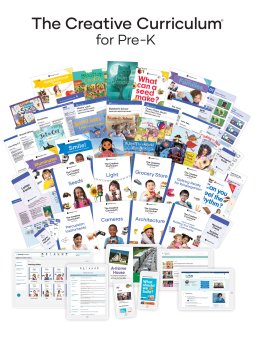
Across Teaching Guides, Foundation Volumes, Book Discussion Cards, Intentional Teaching Experiences, and Mighty Minutes, the materials consistently incorporate direct instruction alongside open-ended inquiry, experiential learning, and play-based exploration. These approaches are evident across all studies, including Seeds, Light, Cameras, Grocery Store, and Buildings, and provide children with multiple pathways to engage with the content.
Overall, The Creative Curriculum for Pre-K intentionally integrates direct instruction with inquiry-based, experiential, and play-based learning opportunities, allowing children to engage with content through exploration, interaction, and guided practice. While direct instruction is present and supports concept introduction, it is not consistently used for explicit, intentional skill instruction. However, the varied and integrated instructional approaches demonstrate that the curriculum meets expectations for leveraging multiple learning modalities to support children’s engagement and understanding.
Indicator 3.2b
Curriculum materials include a range of engaging and developmentally-appropriate experiences that build on and advance student learning.
The Creative Curriculum for Pre-K materials meet expectations for supporting experiences that build on and advance student learning (3.2b).
TThe materials Studies approach, as outlined in the Curriculum Guide, is organized around a three-phase design—Exploring the Topic, Investigating the Topic, and Celebrating Learning—that supports children in building understanding over time (Curriculum Guide, pp. 24–25). This structure intentionally encourages children to activate and share prior knowledge while connecting new content to their lived experiences. During the Exploring the Topic phase, teachers create “What We Know” and “What We Want to Learn” charts, prompting children to reflect on what they already understand and to generate questions that guide inquiry. Daily lesson plans further support this process by providing teacher prompts that elicit children’s ideas and help connect new learning to familiar experiences.
As children move into Investigating the Topic, they engage in activities that deepen understanding and promote meaningful connections between prior knowledge and new information. Teachers guide children to review study materials such as books and photos, interview experts, role-play scenarios, and conduct hands-on inquiries. These experiences allow children to extend their thinking, test ideas, and apply learning across contexts. Throughout investigations, lessons integrate movement, music, storytelling, art, dramatic play, and sensory exploration, offering a range of learning modalities and multiple entry points for engagement.
The Celebrating Learning phase further reinforces agency and collaboration by providing opportunities for children to synthesize and share their learning. Through collaborative displays, presentations, and culminating activities, children reflect on what they have learned and communicate their ideas to others, reinforcing connections and deepening understanding.
The materials provide a meaningful balance of instructional settings that support collaboration, independence, and differentiated learning. Whole-group meetings, small-group investigations, and individualized opportunities are embedded throughout daily lessons, allowing teachers to scaffold learning, observe children’s thinking, and extend understanding as needed. These varied settings promote social interaction and collaboration, enabling children to engage with peers in different ways while also supporting agentic learning. Children are encouraged to initiate, extend, and shape their own learning through inquiry, play, and project work.
Overall, The Creative Curriculum for Pre-K includes activities and resources that activate prior knowledge, connect new learning to existing understanding, and engage children through a wide range of modalities and instructional settings. Opportunities for collaboration, inquiry, and child-initiated exploration are embedded throughout the Studies approach, supporting agentic learning and meaningful engagement.
Indicator 3.2c
Curriculum materials include opportunities for diverse instructional settings and structures.
The Creative Curriculum for Pre-K materials meet expectations for including opportunities for diverse instructional settings and structures (3.2c).
The materials include an instructional framework that integrates whole-group, small-group, and individualized learning experiences to engage all children in meaningful and developmentally appropriate ways. Daily lesson plans embed interactive and inclusive whole-group activities that bring the class together through shared inquiry, discussion, music, and storytelling. Whole-group routines such as Focused Project Learning, Read-Alouds, and Large Group Round-Up are consistently included in daily plans across studies. Building Your Classroom Community further establishes strong whole-group structures through six weeks of daily meetings where children greet one another, sing inclusive songs in English and Spanish, and collaboratively develop classroom rules.
Small-group learning opportunities are embedded throughout the curriculum in Focused Language & Literacy, Focused Mathematics, and Guided Discovery, providing instruction supported by teacher guidance and peer interaction. Individualized learning opportunities are woven throughout daily routines and instructional experiences. The Intentional Teaching Experiences cards (ITEs) include teacher-planned experiences that can be implemented throughout the day in small-group, large-group, outdoor, and one-on-one experiences. Each ITE provides guidance including the following: steps to follow, materials to gather, preparation that may need to be done in advance, additional ideas for adapting the activities for different developmental levels, questions to guide observations, QR Codes that links to videos of a subject-matter expert sharing information and strategies related to the experience, and a teaching sequence that explains how to individualize the activities and scaffold children’s learning.
Predictable routines and smooth transitions are intentionally designed to support consistency, emotional security, and independence. Volume 1: The Foundations and all Teaching Guides establish a predictable daily flow that is consistent across studies. Mighty Minutes cards are included that provide short, engaging learning experiences during transitions, including Simon Says (#13), Scat Singing (#14), Say It, Show It (#15), and Choose the Moves (#205). The First Six Weeks Teaching Guide (pp. 60, 145) explicitly models early-year transition routines and cues.
Overall, The Creative Curriculum for Pre-K includes varied whole-group, small-group, and individualized learning opportunities, supported by guidance for predictable routines and smooth, engaging transitions. The intentional integration of print and digital resources ensures teachers can implement interactive, inclusive, and developmentally aligned instructional structures throughout the day.